See, track, and act on-device


Detections on the aircraft's own compute.
How it works
Camera to detection bus, all on the companion
Frames flow from the camera through inference and tracking, then out on a local detection stream that plugins subscribe to. Inference never leaves the vehicle.
Capabilities
A registry, not a single model
Fetch, download, and cache detection models on the companion. Models stay on the device and run locally.
Sideload your own model from Mission Control. The agent records the file's SHA-256 in its model catalog.
The agent matches the model variant to the board family and the NPU TOPS its board profile declares.
GPS-denied position hold is a separate install: the ADOS Vision Navigation extension reads the frame bus and feeds the flight controller optical flow over MAVLink.
Hardware
Three inference backends
The registry carries a model variant per backend. A Rockchip board routes to its NPU automatically, a Pi 5 with an AI HAT+ selects Hailo in its config, and a board with no accelerator runs the detector on the CPU through ONNX Runtime.
| Item | Hardware | Model file | Selection |
|---|---|---|---|
| Rockchip RKNN | 0.8 to 6 TOPS NPU | .rknn | Automatic on Rockchip boards |
| Hailo-8 / 8L | Pi AI HAT+ | .hef | Chosen in config |
| CPU ONNX | Any Linux board | .onnx | Automatic without an NPU |
Rockchip RKNN
Hardware (0.8 to 6 TOPS NPU), Model file (.rknn), Selection (Automatic on Rockchip boards)
Hailo-8 / 8L
Hardware (Pi AI HAT+), Model file (.hef), Selection (Chosen in config)
CPU ONNX
Hardware (Any Linux board), Model file (.onnx), Selection (Automatic without an NPU)
Vision navigation
Position hold without GPS, from optical flow
Vision navigation is an extension, not part of the agent. Install it from the registry and a downward camera feeds the flight controller a 30 Hz angular-flow measurement over MAVLink.
Install it from the extension catalog
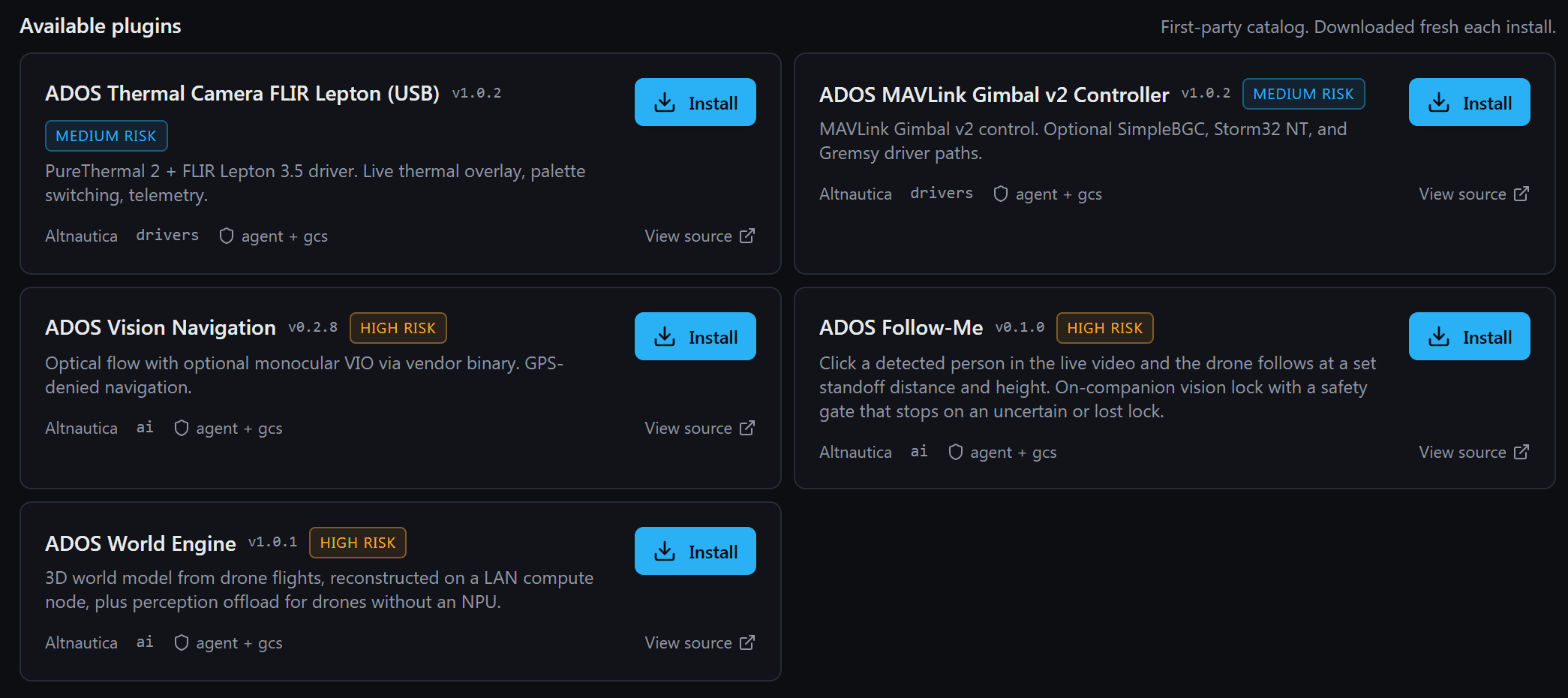
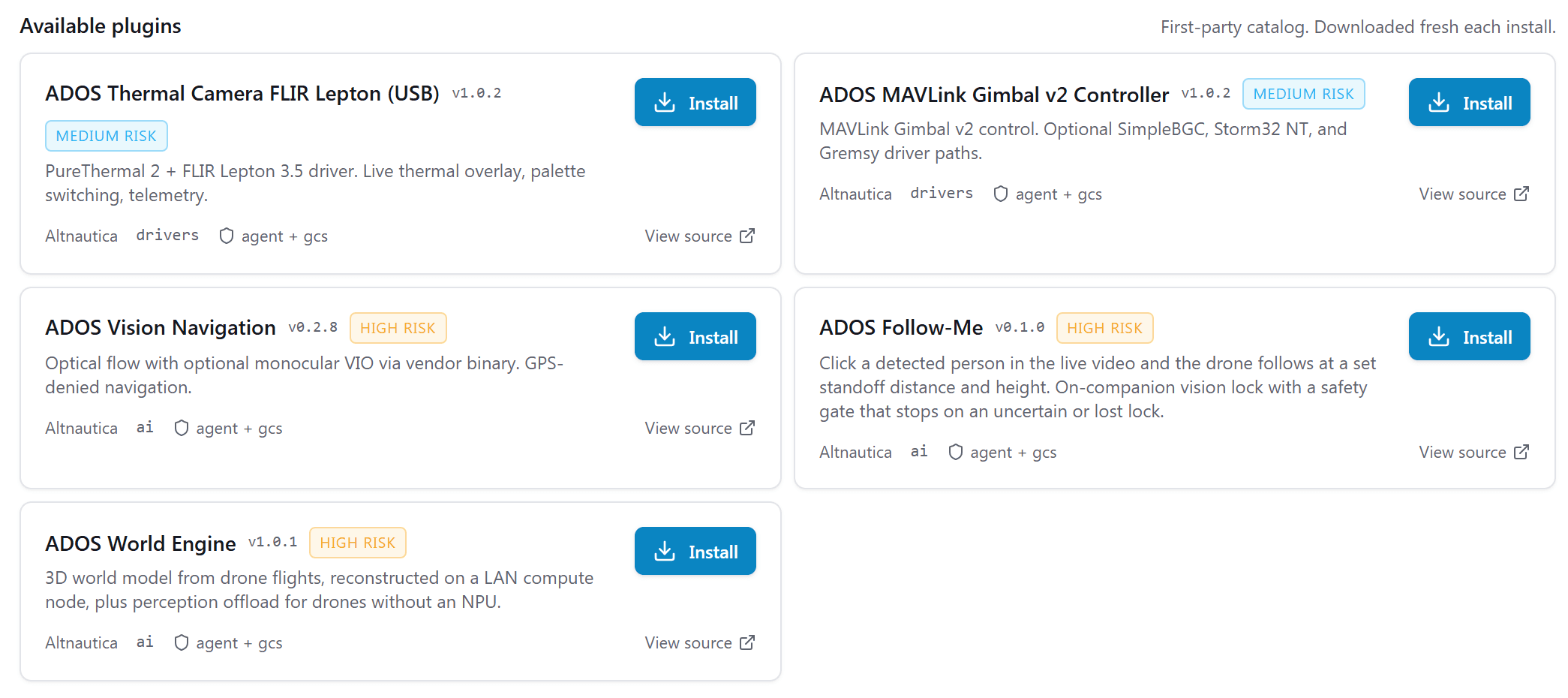
The drone agent's web UI lists the extensions the aircraft can run. Vision navigation installs from there like any other plugin.
Three modes
Every tick the extension checks itself. If flow quality drops or the scale source goes unhealthy it steps down the scale ladder and warns the ground station at each step; a sustained degraded streak flips the node to CRITICAL.
- Optical flow + rangefinderLow altitude, textured ground
- Optical flow onlyBaro or GPS scale, drifts above 5 m
- Off
Works with a stock flight controller
ArduPilot 4.5+, PX4 1.14+, and iNav 7.0+ on a USB UVC or CSI camera, with a Kalibr camera calibration file and a per-mode pre-arm gate. There is no visual-inertial odometry in the pipeline.
Put vision on your drone
The model registry is open-source and documented on GitHub. Bring your own model or start from the catalog.
View on GitHub